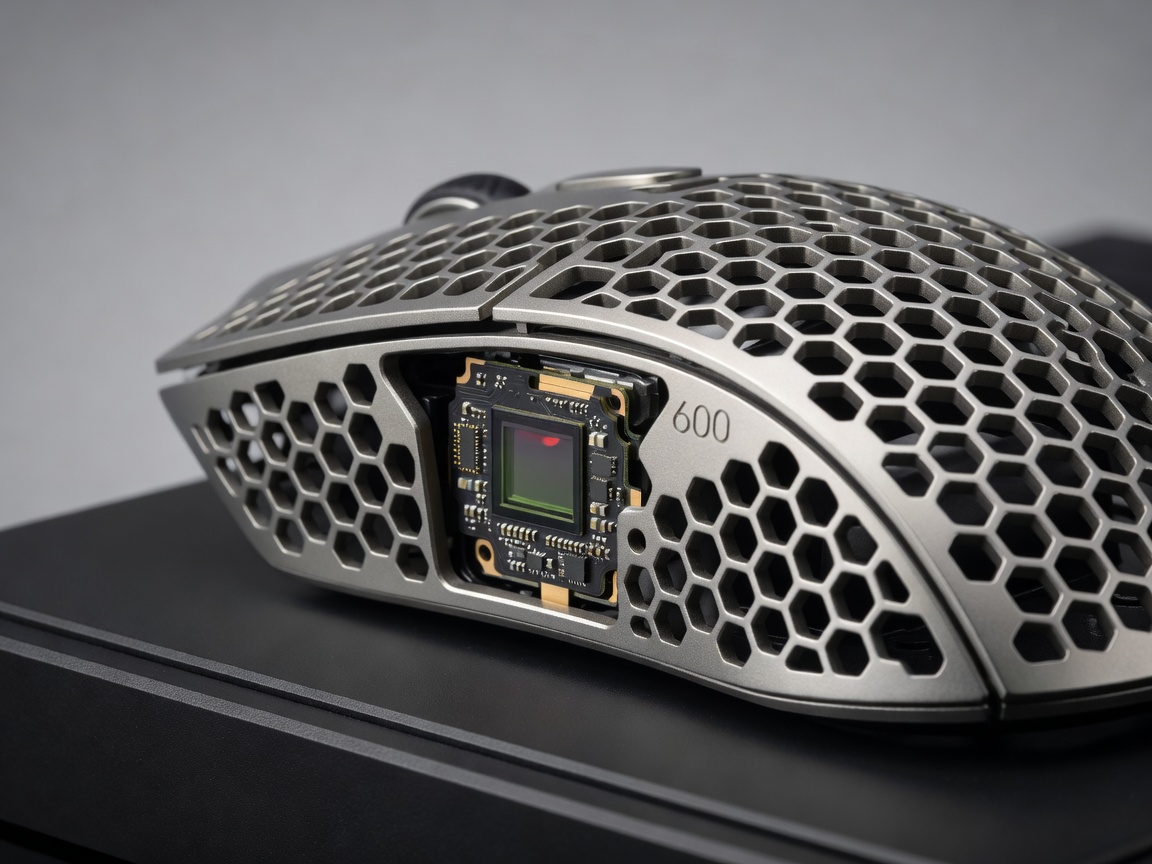
1. Structural Dynamics of Sub-50-Gram Mouse Chassis
The movement to reduce mouse mass below 60 grams, and increasingly below 40 grams, is driven by the physical law of inertia (F = ma). Lower mass minimizes kinetic friction upon initial movement and allows for rapid directional stops without overshoot caused by wrist deceleration. However, trimming mass without compromising shell rigidity presents substantial structural engineering challenges.
Early lightweight peripherals used external honeycomb perforation in ABS injection-molded plastics. While effective for mass reduction, this approach exposed delicate electronic components to sweat, moisture, and dust, while compromising sidewall stiffness. Contemporary designs utilize thin-wall injection molding (0.8mm to 1.0mm wall thickness) with internal rib lattices, composite carbon-fiber weaves, or cast magnesium alloys. These materials maintain rigidity under forceful grip styles while keeping total assembled mass between 38 and 52 grams.
2. Sensor Telemetry: PixArt and Custom Optical Pipelines
Modern optical sensors operate as miniature high-speed cameras, illuminating the mousepad surface with an infrared LED or laser and capturing thousands of surface frames per second. An integrated digital signal processor (DSP) runs optical flow algorithms, comparing microscopic surface imperfections between consecutive frames to compute displacement coordinates along the X and Y axes.
Key operational parameters determine sensor performance:
- Resolution (Counts Per Inch / CPI): The number of discrete measurements reported per physical inch of travel. While marketed up to 30,000 CPI, competitive play typically standardizes between 400 and 1,600 CPI to avoid sensor-smoothing latency.
- Tracking Speed (IPS - Inches Per Second): The maximum velocity the sensor can traverse before losing surface correlation. High-end sensors exceed 650 to 750 IPS, surpassing human physical arm-sweep capability.
- Maximum Acceleration (G): The rate of velocity change the sensor tolerates without losing tracking synchronization, typically rated up to 50G or 70G.
- Lift-Off Distance (LOD): The elevation above the pad at which the sensor stops reporting coordinates. Sub-millimeter LOD (0.7mm to 1.0mm) prevents unwanted crosshair drift when re-centering the mouse.
3. Optical Switch Debouncing vs. Mechanical Leaves
Just as in keyboards, conventional mouse switches rely on metallic contacts that can suffer from contact degradation and unintended double-clicking when operating at low debounce delays. Optical mouse switches eliminate this issue by directing an internal infrared light beam across an unobstructed path inside the switch casing.
Depressing the mouse button lowers an internal shutter that cuts or unblocks the infrared beam onto a photo-detector. The electrical state transition registers nearly instantly—typically within 0.2 milliseconds—without the need for debounce latency loops. Furthermore, with zero mechanical wear from electrical arcing, optical switches maintain consistent tactile tension and switch longevity over tens of millions of clicks.
Sensor Architecture & Latency Reference
| Parameter | Standard 1000Hz Bus | High-Rate 4000Hz Bus | Ultra-High 8000Hz Bus |
|---|---|---|---|
| Packet Report Interval | 1.0 millisecond | 0.25 millisecond | 0.125 millisecond |
| Frame Latency Variation | 0.1ms to 1.0ms jitter | 0.05ms to 0.25ms jitter | <0.05ms jitter |
| Wireless Battery Impact | Baseline (70-90 hrs) | ~40% to 50% Reduction | ~65% to 75% Reduction |
| Host CPU Overhead | Negligible (<0.5%) | Low (1% to 2%) | Moderate (2% to 6%) |
4. Wireless Transceiver Protocols & Polling Rates
Cutting the cord without introducing input latency has been enabled by 2.4GHz proprietary radio frequency (RF) protocols. Modern transceivers utilize frequency-hopping spread spectrum (FHSS) algorithms to avoid interference across crowded wireless bands, transmitting telemetry packets directly to an MCU receiver with sub-millisecond dispatch cycles.
When running at 4,000Hz or 8,000Hz, the mouse sends motion coordinate packets every 0.125ms. On high-refresh displays (such as 360Hz or 540Hz panels), this tight reporting interval smooths out micro-stutter by ensuring that the operating system cursor position matches the latest frame render cycle. However, high polling rates place higher demands on host CPU thread scheduling and reduce battery life, making battery capacity management a key factor in ultralight wireless engineering.