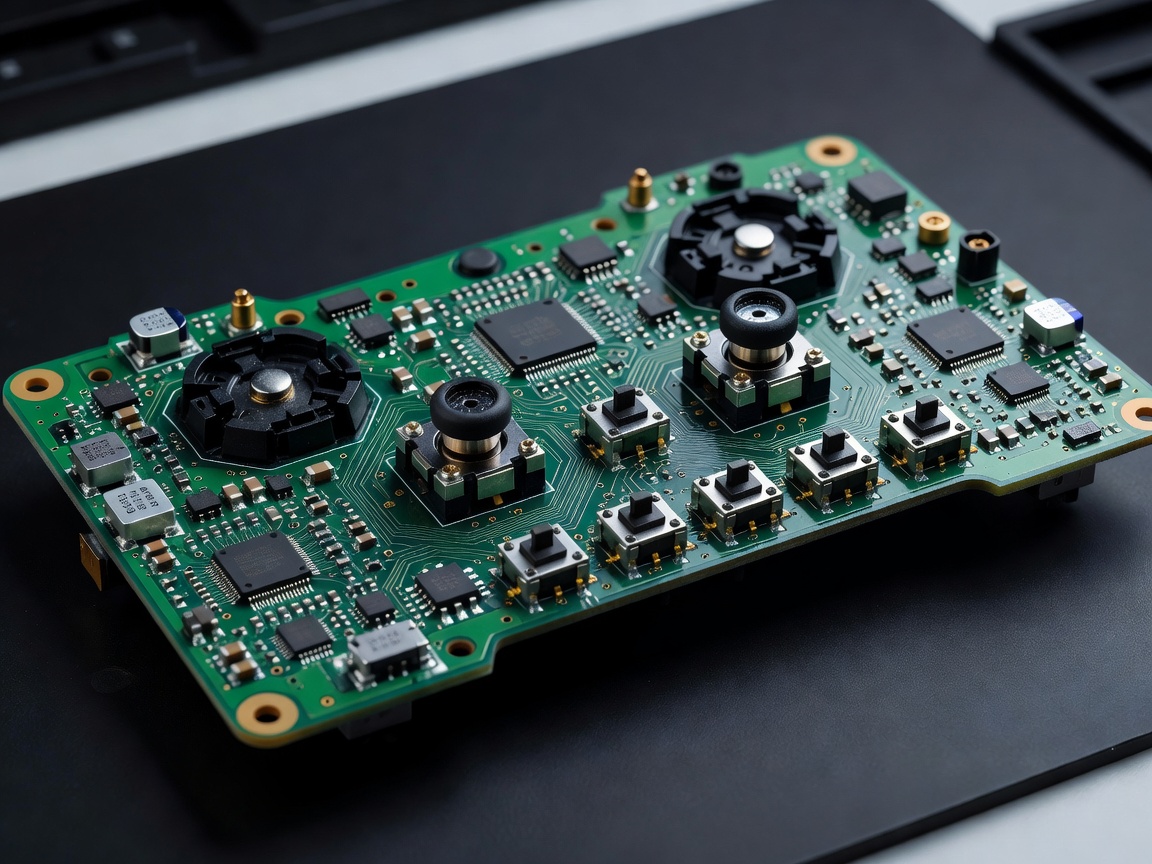
1. The Mechanical Failure Mode of Potentiometer Joysticks
For decades, gaming controllers have relied on carbon-film potentiometer gimbals. In these mechanisms, moving the thumbstick rubs a metal wiper arm across a carbon resistive track to alter electrical resistance and signal position coordinates to the controller MCU.
This physical contact makes wear inevitable. Over time, microscopic carbon particles slough off the track, creating uneven electrical resistance, signal noise, and false inputs known as stick drift. To compensate, players are forced to increase their deadzones in game settings, sacrificing responsiveness and subtle aiming adjustments near the stick's center.
2. Hall-Effect Electromagnetic Gimbal Engineering
Hall-effect thumbsticks eliminate the physical contact wear cycle. Two permanent magnets mounted to the rotating axis pivot freely over magnetic field sensors mounted on the circuit board. As the stick tilts, the sensor detects variations in magnetic flux density without physical contact.
This frictionless design provides two major advantages:
- Near-Zero Stick Drift: Because there is no carbon film to wear down, the electrical center remains consistent over millions of rotational cycles.
- Zero Deadzone Accuracy: Players can lower digital deadzones close to zero percent without experiencing phantom inputs, providing instant, linear crosshair movement.
- Centering Precision: High-tension mechanical return springs and machined aluminum pivots provide repeatable return-to-center tension within 1% error margins.
3. Microswitch Face Buttons vs. Conductive Rubber Membranes
Standard gamepads utilize conductive carbon pills positioned beneath flexible silicone rubber membranes. When pressed, the rubber domes collapse to short two PCB traces together. While inexpensive and quiet, rubber membranes have a mushy bottom-out, unpredictable actuation depth (typically 1.2mm to 1.5mm), and can deteriorate unevenly with heavy use.
Modern competitive gamepads replace rubber membranes with tactile surface-mounted microswitches, similar to those found in gaming mice. These microswitches feature a short actuation travel (0.3mm to 0.6mm), a crisp tactile click, and a rated lifespan of up to 5 to 10 million presses. The short travel distance substantially reduces the physical time required to execute complex combos and rapid inputs.
Controller Interface & Input Telemetry
| Component System | Hall-Effect Competitive Pad | Legacy Console Gamepad | Programmable Macro Deck |
|---|---|---|---|
| Joystick Sensor Type | Electromagnetic Flux (Hall) | Carbon Film Potentiometer | Rotary Encoder Dial Array |
| Face Button Switches | Tactile Microswitch (0.3mm) | Conductive Silicone Dome | Cherry MX Mechanical / Scissor |
| Native Bus Polling | 1000Hz (1.0ms Report) | 125Hz - 250Hz (4-8ms) | 500Hz - 1000Hz USB HID |
| Mechanical Lifespan | >5,000,000 Gimbal Cycles | ~500,000 Cycles to Drift | >50,000,000 Key Presses |
| Programmable Macro Layers | Hardware Kernel Profile Remap | Software Console Remapping | Multi-Layered Action Scripts |
4. Dedicated Stream Decks and Automation Control Surfaces
Alongside competitive controllers, dedicated macro keypads and stream decks have become essential tools in gaming and broadcasting setups. Unlike software overlays that steal application focus, dedicated macro hardware connects as an independent USB Human Interface Device (HID).
High-end control surfaces feature LCD-backed transparent keycaps, rotary encoders with tactile detents, and onboard memory processors. Microcontrollers execute automated multi-action sequences—such as audio scene switching, OBS transitions, and telemetry overlays—entirely through local firmware, avoiding CPU thread interrupts and ensuring smooth game framerates.