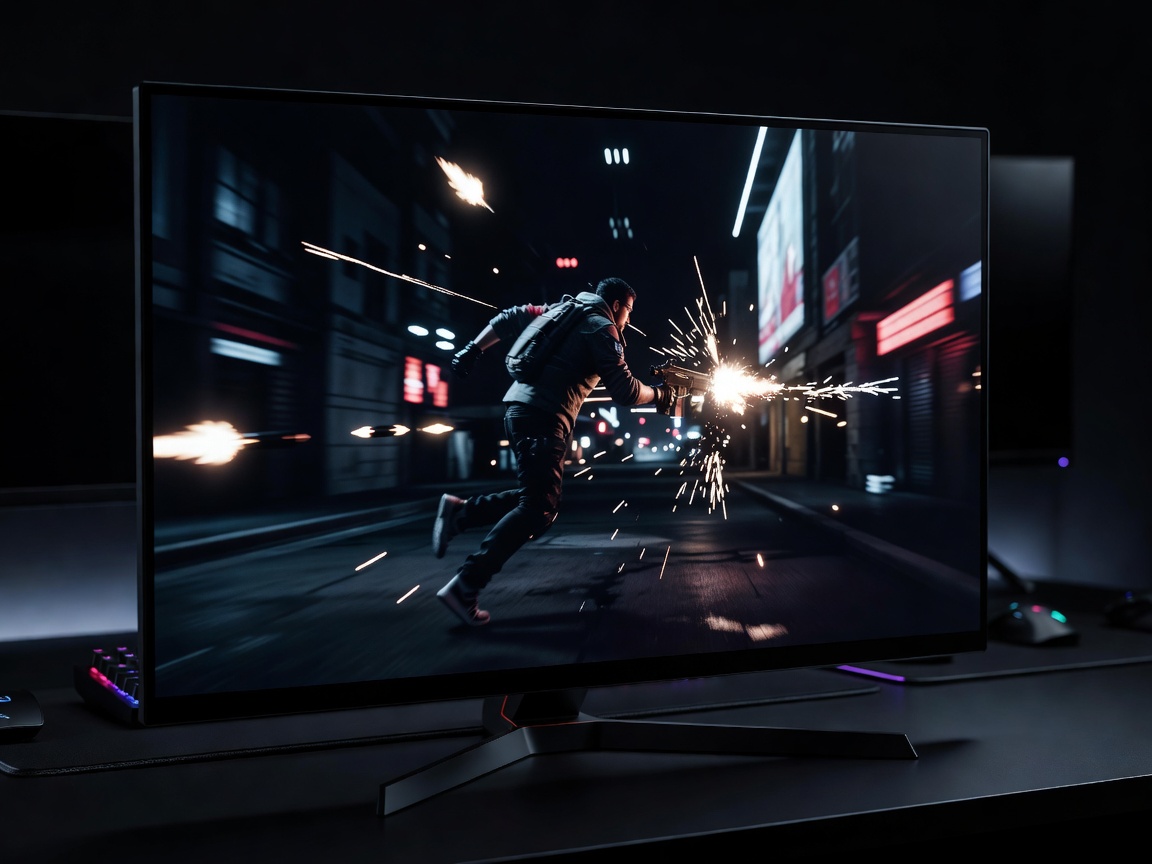
1. The Frame Presentation Window at 240Hz, 360Hz, and 540Hz
In competitive gaming monitors, the refresh rate determines the temporal window available for each individual frame. At standard 60Hz, each frame remains on screen for 16.67 milliseconds. As refresh rates scale upward, this window narrows significantly:
- 144Hz: 6.94 milliseconds per frame cycle
- 240Hz: 4.16 milliseconds per frame cycle
- 360Hz: 2.77 milliseconds per frame cycle
- 540Hz: 1.85 milliseconds per frame cycle
This reduction in frame duration provides two key advantages: it shortens system-level input lag by displaying new GPU frame renders sooner, and it reduces perceived retinal motion blur caused by eye tracking across sample-and-hold display panels.
2. Pixel Transition Dynamics: Gray-to-Gray (GtG) Limits
A high refresh rate cannot compensate for sluggish pixel transition times. If a monitor refreshes every 2.77ms (360Hz), but the liquid crystal molecules require 5.0ms to rotate from one shade of gray to another, the pixel transition will carry over into subsequent frames. This results in ghosting, smearing, and a loss of fine target detail during fast camera pans.
In Fast-IPS and TN panels, manufacturers apply voltage overdrive to force liquid crystal molecules into position more rapidly. While effective, excessive overdrive creates "inverse ghosting" or corona artifacts—bright or dark trailing halos caused by the pixel overshooting its target luminance before settling. Balancing overdrive algorithms across variable refresh ranges remains a primary challenge in LCD scaler engineering.
3. OLED & QD-OLED: The True Sub-Millisecond Transition
Organic Light Emitting Diode (OLED) and Quantum Dot OLED (QD-OLED) architectures eliminate liquid crystal molecules entirely. Because each individual subpixel is an organic compound that emits its own light when voltage is applied, pixel color changes happen almost instantaneously.
While LCD panels typically transition in 1.0ms to 4.0ms, OLED pixels switch within 0.03ms (30 microseconds). As a result, pixel transitions are nearly instantaneous relative to the refresh cycle. Even at 240Hz, an OLED panel can deliver clearer moving targets than a 360Hz LCD, as its presentation is free from overdrive trails and color smearing.
Display Technology Engineering Comparison
| Specification Parameter | Fast-IPS (540Hz Class) | QD-OLED (360Hz Class) | Standard IPS (144Hz) |
|---|---|---|---|
| True Average GtG | 1.2ms to 2.5ms (Overdriven) | 0.03ms (Instantaneous) | 4.5ms to 8.0ms |
| Frame Duration | 1.85 milliseconds | 2.77 milliseconds | 6.94 milliseconds |
| Contrast Ratio | 1,000:1 (Static Backlight) | Infinite (>1,500,000:1) | 1,000:1 |
| Motion Blur Source | Eye Tracking + LC Delay | Eye Tracking Sample-and-Hold | Severe LC Liquid Sluggishness |
| Long-Term Burn-In Risk | Zero (Inorganic Crystals) | Mitigated by Pixel Shifts | Zero |
4. Backlight Strobing vs. Sample-and-Hold Mechanics
Even with instantaneous 0.03ms pixel switching, human eyes experience motion blur due to retinal persistence over sample-and-hold frame presentations. When an object moves across the display, the human eye smoothly tracks its anticipated path, while the display holds the static frame in place until the next refresh. This discrepancy between continuous eye movement and stationary frame steps blurs the image across the retina.
Backlight strobing (such as DyAc or ULMB) addresses this by inserting brief moments of darkness between frame refreshes. By pulsing the backlight only when pixels have finished transitioning, the eye receives a series of sharp, instantaneous snapshots rather than an illuminated smear. However, strobing reduces overall panel luminance and can cause visual fatigue for sensitive users, requiring careful duty-cycle configuration.